When Magnolia Bakery cupcakes appeared on Sex and the City, it triggered a big bang that reverberates a quarter century later. Pop culture turned a childhood treat into an aspirational icon, altering the psycho-social fabric and neighborhood character of Greenwich Village and beyond. Cupcakes’ impact on society, culture, and the economy is analyzed on the occasion of the 25th anniversary of the cupcake scene in July 2025.
Cupcakes were the first viral food of the 21st century. It was 2000 when a big bang propelled cupcakes into the stratosphere. Now comes the 25th anniversary of the inciting incident, a TV episode that redefined the iconography of cupcakes.
Sex and the City, which aired on HBO from 1998 to 2004, catalyzed the modern cupcake moment through this sequence of events.
1. Magnolia Bakery opened in New York City in 1996. It sold cupcakes and influential people took a liking to them. Word spread. Demand grew. Lines formed.
2. An actress named Sarah Jessica Parker patronized the bakery, located near her home in Greenwich Village.
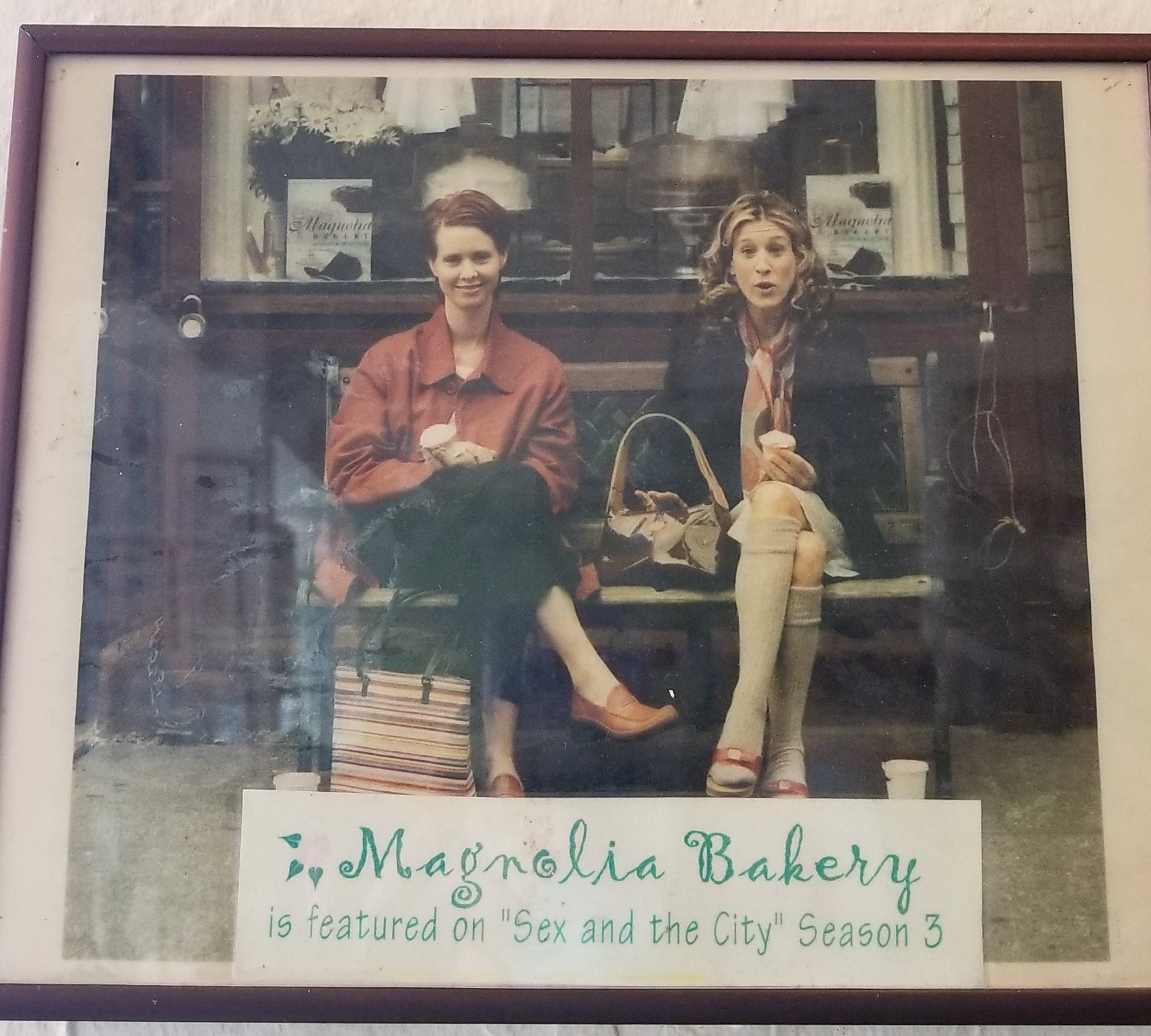
3. Parker was cast in Sex and the City. In the show’s third season, Parker masterminded a scene in which two characters eat cupcakes while sitting on a bench outside Magnolia Bakery. The scene aired on July 9, 2000.
4. Cupcakes gained cultural cachet as symbols of big-city glamour. Widely accessible and affordable, they became a pleasurable taste of the good life. A tour bus began shuttling visitors to Sex and the City sites, including Magnolia Bakery. Inconceivably longer lines formed. Women’s magazines and daytime TV talk shows fueled the momentum. Enterprising bakers around the country and world opened Main Street cupcakeries.
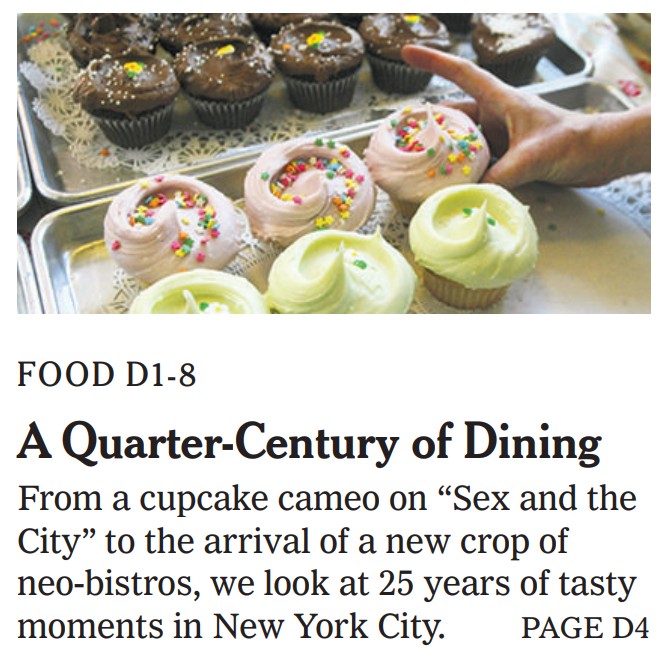
In “25 Years of N.Y.C. Dining,” the New York Times highlights “major food moments … that changed life in New York City in the first quarter of the 21st century.” Magnolia cupcakes are the first entry in the timeline, published in the May 28, 2025 print edition. Of all the imagery that could have been chosen for the front-page teaser, it is Magnolia cupcakes that are pictured.
When the West Village caught cupcake fever
Jennifer Appel and Allysa Torey opened Magnolia Bakery in the closing years of the 20th century. The digital revolution hadn’t occurred. Upscale chain stores and luxury apartments weren’t omnipresent in Lower Manhattan. Television shows, economic forces, and terrorist attacks would alter the collective psyche and the physical landscape, but these weren’t factors when the two 30something friends leased a 650-square-foot corner storefront.
“The Magnolia Bakery came into being over a brunch conversation during which we expressed for the umpteenth time our mutual frustration with our jobs and lifestyles,” write Appel and Torey in The Magnolia Bakery Cookbook. “We finally decided something would be done about it and opened up a wholesale baking business in early 1996. […] When a retail space became available in our favorite neighborhood, the western part of New York City’s Greenwich Village, we grabbed the opportunity. The West Village seemed ideal. It is low-key and family-oriented, a place where we can do what we love where we love it. Over the course of two months and with the help of an adept construction crew, we transformed an empty shell into a warm, cozy kitchen that feels ‘just like Mom’s.’ We scoured the flea markets and vintage stores to buy just the right furniture, decorations, and lighting fixtures to create an inviting atmosphere. Most people who walk in say they feel as if they have gone back in time to ‘Mom’s’ or ‘Grandma’s’ kitchen …”
Concerning the customer base and workday, “[W]e imagined a cozy, old-fashioned shop where people could come for a cup of coffee and something sweet,” Torey writes in The Complete Magnolia Bakery Cookbook: Recipes from the World-Famous Bakery and Allysa Torey’s Home Kitchen. “We expected our customers to include some local regulars and lots of neighborhood families. We thought we’d close at seven each evening so we could go home and make dinner.”
Magnolia Bakery is located on Bleecker Street, a 20th-century mecca for artists, intellectuals, and political activists. When Magnolia opened, small businesses lined the street, providing essential goods and services plus specialty products. Bird Jungle pet shop was the previous tenant of the space Magnolia rented.
Months after opening, Torey and Appel were baking cakes of different sizes and had leftover batter in their mixing bowls. They eyed the empty muffin tins from the breakfast bakes. Into the tins went the batter and cupcakes made their fateful debut in the pastry case.
The cupcakes caught attention and demand quickly grew to the point that a one-dozen-per-person limit was imposed. “With only word of mouth for advertising, people from all over Manhattan, the outer boroughs, the suburbs, and even as far away as Iowa order our desserts,” the co-owners write in their 1999 cookbook. “There is usually a long line out the door at nights and on the weekends, as people buzz around our store like bees in a hive, scooping up the last of our sweet creations.”
Former Wall Street Journal columnist Ralph Gardner, Jr. was a customer in the early days. “When it took a special trip to get there, you felt a member of some cupcake cognoscenti, with a staff that was at once attentive, indifferent, and often highly tattooed,” writes Gardner. “While they made your espresso or cut a slice of devil’s food cake, you assumed they were conceptualizing their installation at the Tate Modern.”
In 1999, the New York Times reported on cupcakes’ rising popularity. “Once seen only at bake sales and single-digit birthday parties, cupcakes are turning up as adult fare at corporate events, dinner parties and fancy-food shops,” writes reporter Ellen Tien, naming half a dozen Manhattan bakeries selling cupcakes.
On network TV, Seinfeld and Friends were painting an appealing picture of city life. On HBO, Sarah Jessica Parker was starring in Sex and the City. Magnolia was in her neighborhood and she patronized it. At Parker’s initiative, Magnolia became the setting of a scene in the third season. In the iconic scene, Parker’s Carrie character and Cynthia Nixon’s Miranda sit outdoors eating vanilla cupcakes with pink frosting. The location is identifiable only because The Magnolia Bakery Cookbook is visible in the background, displayed in the bakery window. The scene runs about 75 seconds. It thrust cupcakes over a tipping point.
The new cupcake world order necessitated a bouncer to control Magnolia’s door. The bakery stayed open late for nightclubbers. “The mob of wiggly adults on line for buttery warm cupcakes was unruly” around midnight one Saturday in 2001 when reporter Bob Morris went to observe. “‘Hey, I was here first,’ a stubbled man bellowed. Fashionable adults who should have been at hot spots like the Park or Man Ray were trying to cut in line. They grabbed cupcakes frosted in bright pink, lime green, and other resort colors (as well as the new brown, of course) with desperate hands, as if they were cigarettes or caipirinhas. ‘You told me the line starts here,’ a guy in leather pants yelled at a cashier.”
Whatever frustration he met indoors, that “guy in leather pants” had made it past the bouncer. Author Jason Diamond held the job for one year. “I’d stand there night after night looking into [customers’] eyes, trying to piece together what terrible events led them to stand outside of a bakery at 8:30 on a cold December evening or muggy summer night,” writes Diamond. “I was the gatekeeper and I was the key master. I had to stand there sometimes for up to six hours, making small talk with the Millers from Iowa who couldn’t believe there was a store that just sold condoms a block away from the bakery (RIP condom shop). I had to ignore the guy in the suit who told me the only reason I wasn’t letting people in was because I wanted to feel some sense of power in my ‘pathetic life.’ It was actually because we had run out of cupcakes.
“I was the first face you saw upon entering, and I was the last one you saw when you were leaving, unless, of course, you were the type of person that ran past me so you could triumphantly hoist your one cupcake that you waited 45 minutes for into the air like it was the Stanley Cup. That happened at least once a night.”
Writer Alexandra Wolfe bore witness on a “balmy Sunday night” in 2002. “It seemed as if every New Yorker not home snuggling with their spouse in front of The Sopranos was part of the crowd spilling onto Bleecker Street,” writes Wolfe. “There were half-nibbled iced cupcakes in their hands and rapturous expressions on their faces. Some were enjoying their sugar fixes in a daze, wandering in slow circles in a dingy, vermin-infested park across the street.”
On Location Tours began a Sex and the City tour of Manhattan sites seen on the show, including Magnolia. Twice daily and three times on weekends, dozens of tourists spilled from a motorcoach parked near the bakery. When it began in 2001, the tour served Magnolia cupcakes, but this became unsustainable and other cupcakes were then substituted.
“One thing that always stood out to me was the distinction between ‘weekday’ Magnolia and ‘night and weekend’ Magnolia,” says former manager Margaret Hathaway. “When I first started working there in the summer of 2001, during the week, we had tables with regulars who lingered over coffee and a muffin. We worked at a brisk pace, but weekdays were when we refreshed the flowers, changed the vintage cloths in the windows, picked up the garbage, swept the sidewalk, and caught up on cleaning, organizing, etc. The soundtrack was usually jazz standards, people came in to order birthday cakes, and it really did feel a bit like a time capsule from an earlier era. Nights and weekends were a different story—nonstop customers at a breathless pace, louder music, more celebrities, just a different world.”
The unrelenting demand forced Magnolia to revise operations. A 2003 New York Times story notes that “[a]t 9:30 a.m. the metal gates are still down at Magnolia. No longer open for breakfast, the bakery must use that time to make cupcakes: 3,000 will be sold before the day is out. … Shouting is heard on the sidewalk: the expensive florist who moved in when the birds were priced out is angrily tossing cupcake wrappers out of his sidewalk planters. On another night at midnight, the line still snakes out the door, and tourists pose for pictures, proudly holding cupcakes frosted in pale green and lavender for the cameras.”
In a 2004 essay, former Magnolia general manager Barbara DiNicola contrasts the bakery’s opening days to the mid-aughts dynamic. “Cherished customers looked wistfully to that first summer when there was no limit on cupcakes per person, when lines never wrapped around the block, when the nightly staff was Allysa [Torey, who became the sole proprietor], my sister Shelly, and myself,” she writes in More from Magnolia: Recipes from the World Famous Bakery and Allysa Torey’s Home Kitchen. “Visit today, and the cast has quadrupled, the bakery is unremitting, and as many as five people have the sole task of icing cupcakes.”
From his home a block away, veteran food critic Robert Sietsema watched the bakery permutate into a destination. “German, French, and Japanese tourists appeared, noses deep in their guidebooks, and the place eventually came to be considered an annoyance by the folks who lived nearby,” Sietsema writes. “Cars double parked in the bike lane out front, the engines still running, as the occupants scrambled out to stand in line. Cupcake fanatics took over adjacent Bleecker Park and came to occupy every table at peak evening hours and on weekends. They would buy several cupcakes apiece, daintily eat them with a fork, and then some would throw their trash on the ground or simply leave it on the table. … On busy nights every trash can within a two-block radius overflowed with Magnolia Bakery bags, boxes, and napkins.”
Duane Scott Cerny had a direct sightline to Magnolia from his apartment 50 yards away. He saw an “endless line of people standing outside Magnolia Bakery every day from mid-afternoon to late into the evening. In every kind of weather imaginable, the line would extend from the door of the bakery in numbers seldom fewer than 50, and more often 100 plus. And though the line moved smoothly, it remained intact for hours on end, like a favored ride at Disneyland.”
He observed the extremes to which at least one person went. “It’s 2 a.m.,” writes Cerny in a section of his essay subheaded “This is a True Story. I’m Not Telling it Again.” He watches as a “slick black town car pulls up to the now darkened Magnolia. A young woman jumps out, clearly inebriated, and begins pounding on the bakery’s door. ‘I’ll give you $20 for a cupcake,’ she yells. Inside, a young maintenance man with a bucket waives her off. ‘Come on! $25 then …’ The man turns away. She begins kicking at the door. ‘OK, $50! I’ll give you $50 for one cupcake!’ More unintelligible screaming. ‘OK, how ’bout I **** you for a cupcake!’ And yes, she said ****! The worker scampers to the back of the store and turns off all the lights.”
In a 2008 story, local resident and music critic Jim Farber observes a “tourist-mad thoroughfare, filled with buses belching out bellies-ful of addled picture-snappers by the hour. Hundreds of such folks line the northernmost stretch of Bleecker St., queuing up daily to taste what have to be the most overrated cupcakes in the city. Those would be the cloying pastries sold by Carrie Bradshaw‘s fave sugar stop, Magnolia Bakery, a retro-’50s Betty Crocker nightmare that every local knows pales next to Billy’s in Chelsea and, certainly, to the late, lamented Taylor’s on Hudson.”
Living in a “flat directly opposite” Magnolia, journalist Emma Forrest was “kept awake each night by the hoots and hollers coming from the queue that now snakes all the way around the block. … I felt as if I was living across the road from Studio 54 in its 1970s heyday. It was awful. It was time to move house.” She left the neighborhood, unsettled “not by gangs of rampaging teenagers, or constantly arguing neighbours, but by a purveyor of cupcakes.”
Tara Settembre saw her proximity to Magnolia as a positive. An early lifestyle blogger, Settembre resided a block from the bakery. “When my friend stopped by on a Saturday night, we waited for 20 minutes in the cold, lined up on 11th Street,” she blogs. “In line we spoke with a gay couple who also live nearby and have been coming here for years for the German chocolate cake. In front of us were two groups of young women from D.C. and California, posing for photos underneath the blue awning marked Magnolia Bakery.”
Cupcake runs were a routine part of Settembre’s life in the mid-aughts. “[A]s soon as the lines were gone (usually late at night), I’d sneak over for a vanilla cupcake with my friends, sometimes in my PJs even,” she tells the Cupcakes Take the Cake blog. “I don’t know when my obsession started, though, somewhere around when I first moved to New York [in 2004]. Now, I’m obsessed with even the look of cupcakes, so girly and cute.”
Journalist Ralph Gardner, Jr. thought highly of Magnolia as well. “Were I forced to select the top 10 things that have improved the quality of life in this city over the last decade, or even the top five, possibly three, Magnolia would be among them,” he wrote in the Wall Street Journal in 2010.
Millions of consumers saw Magnolia cupcakes in the seminal 2005 video “Lazy Sunday,” starring Saturday Night Live comedians Chris Parnell and Andy Samberg. “Let’s hit up Magnolia and mack on some cupcakes,” the performers rap. “No doubt, that bakery’s got all the bomb frostings. I love those cupcakes like McAdams loves Gosling. Two, no, six, no, twelve—baker’s dozen! I told you that I’m crazy for these cupcakes, cousin.” The comedians display their cupcakes beneath the bakery’s blue awning before opening the box to start eating.
The video was posted to YouTube, which had launched just five months earlier. It became the first blockbuster video on the upstart website, introducing a wide swath of TV viewers to the concept of the online video-sharing platform. “Within days, ‘Lazy Sunday’ was the first TV show clip to have a viral second life online, with 2 million-plus viewings,” writes the Hollywood Reporter. “That week, YouTube’s traffic was up 83 percent.” Noting the billions of views that YouTube now attracts, the article asserts, “some credit for that success goes to Saturday Night Live and cupcakes.”
By this time, Magnolia was owned by a sole proprietor, Allysa Torey. Co-founder Jennifer Appel had sold her half to Torey and opened Buttercup Bake Shop in midtown Manhattan in 1999. Torey spent less and less time at the bakery, instead writing cookbooks in upstate New York. She sold Magnolia to Steve and Tyra Abrams in 2006. Steve Abrams is a restaurant industry veteran who turned the “600-square-foot, $500,000-per-year bakery into a multimillion-dollar business,” writes Jennifer Keishin Armstrong in her 2018 book Sex and the City and Us. Until the ownership change, Magnolia was a single bakery. In short order, it added stores in Manhattan, other U.S. cities, and overseas. In a 2010 analysis, Investor’s Business Daily reported that each Magnolia store was selling one million cupcakes a year. Annual revenue was reported at $20 million in 2012 and $40 million in 2015.
The Sex and the City tour bus was bringing up to 600 visitors a day to Magnolia’s street. A.A. Gill recounts his tour experience in Vanity Fair. “We’re taken to the Magnolia Bakery, where queues of weirdly excited and messianic women wait impatiently to eat the teeth-meltingly sweet, infantile cupcakes like a votive Communion promising a blessed afterwork life of copious, cool sex, witty friendship, miraculously available taxis, Manolos, Cosmos, and happy-ending aphorisms,” he writes. “We don’t have to line up. Our cakes come with the ticket. Massive trays of cupcakes appear and are offered to us in a tramp’s pissoir alley on slimy benches beside a children’s recreational park. Feeding cake to yearningly single women beside a playground with happy West Village moms and their gilded tots was an act of sadistic patronage. We guiltily stuff our faces, begging the refined calories to transport us into closer connection with the fabled story arc.”
The Associated Press sized up the cupcake dynamic in a 2009 story that begins, “This city is crazy for cupcakes. There are cupcake classes and cupcake tours, lines down the block at cupcake bakeries, a cupcake tea at a five-star hotel, and a cupcake truck with 6,000 followers on Twitter.” Cupcakeries became a “legitimate driver of the city’s economy,” according to a 2010 Wall Street Journal blog post headlined “New York City’s Cupcake Economy.”
Critics of cupcake capitalism included Time Out New York magazine, which examined “how Sex ruined New York City.” A May 2008 edition covered various angles of the Sex and the City phenomenon and tallied its purported offenses. Topping the list was the “douchification of the Meatpacking District and the West Village.” Writes Claire Madigan, “Maybe it was bound to happen due to the economic surpluses of pre-2001, but those surpluses allowed Samantha Jones to move to Meatpacking and Carrie and Miranda to stuff their faces with Magnolia Bakery cupcakes and tromp around the West Village. With the ladies of SATC came careening tour buses, gaggles of fratboys puking outside Hogs & Heifers and rows of women linked at the elbows mowing down pedestrians. Now this part of town is sealed off from the rest of the city with a facade-like glaze of a TV-show set.”
New York became the Big Cupcake, according to downtown performance artist Penny Arcade. In her view, cupcakes symbolize all that’s lamentable about socio-economic and cultural change. Cupcakes are central to her Longing Lasts Longer show, excerpted in a 2016 video. As she tells it, “There is a gentrification that happens to neighborhoods and cities, but there is also a gentrification that happens to ideas and that is how New York City has gone from being the city that never sleeps to the city that can’t wake up. New York City is in a coma. It’s in a sugar coma. If they’re not eating a macaron, it’s an artisanal gelato. If it’s not an artisanal gelato, it’s a cotton-candy mojito. If it’s not a cotton-candy mojito, it’s probably a cupcake. New York has gone from being the Big Apple to being the Big Cupcake. There are 100 cupcake shops in a 10-block radius of my apartment. People are staggering from one cupcake shop to another, a trail of cupcake crumbs across the city. The cupcake is the narcotic of these new infantilized beings. … While the cupcake may look innocent, the cupcake is malevolent. The cupcake represents what Hannah Arendt called the banality of evil. The gentrification of a poor neighborhood always starts with a café and always ends with a cupcake. The cupcake represents conformity, self-absorption, and selfishness, just like the middle-class values and middle-class manners that have invaded every single f**king corner of New York. Those middle-class manners, those middle-class values, just like the cupcake, they hide the brutality of their entitlement.”
New Yorkers who agree can find suggested recourse in the Grub Street archives. “How Can We Stop Magnolia Bakery’s Carrie Cupcake?” proposes the following retaliatory measures:
“1. ‘Top kill’ the cupcakes by pumping cement and mud into them.
2. Employ ‘jump shot’ method of injecting rubber scraps into the cupcakes.
3. Lower a 40-foot steel box over the cupcakes.
4. Use remote-controlled vehicles to disable the cupcakes.
5. Siphon the cupcakes through a giant funnel.
6. Employ out-of-work shrimp fishermen to place containment booms around the cupcakes.
7. Use suction skimmers to suck the cupcakes into storage tanks.
8. Have robots spray dispersant all over the cupcakes until they break into harmless droplets.
9. Flood the cupcakes until they float away.
10. Employ biological agents to hasten the cupcakes’ biodegradation.
11. Set fires to burn off the cupcakes.
12. Use gelling agents to turn the cupcakes into harmless rubber.
13. Just let weather and microbes break down the cupcakes.
14. Wash the cupcakes away with pressure hoses.
15. Use ‘scare tactics’ such as propane ‘scare-cans’ to keep tourists away from the cupcakes.”
Tourists were hardly deterred when viewing a critical street performance outside Magnolia. Local artist Sue Hogan conceived and choregraphed Unison Fetish, a dance with cupcakes and a song sung to the tune of “God Bless America.” The first verse is “God bless Magnolia / Cupcakes we love / Stand in line here / For a time here / Buy a treat Carrie Bradshaw would love / Bless Ralph Lauren / And Marc Jacobs / All the global luxury brands / God bless Magnolia / Temptations so sweet / God bless Magnolia / And the New Bleecker Street.”
According to author and culture critic Jeremiah Moss, “Consumers stop and take photos. They smile. They seem oblivious to the fact that they are being mocked. True, the mockery is soft, subtle, and could be taken for genuine enthusiasm,” he writes. (Original emphasis).
Hogan explained the genesis to Cupcakes Take The Cake, the pioneering cupcake blog. “The creation of desire and how it is expressed through the transformation of the area around the Magnolia Bakery was my initial inspiration for Unison Fetish. The line outside the bakery, not the bakery itself, symbolized that transformation. I have lived nearby in a rent-stabilized apartment since 1993, and watched the area of Bleecker Street below Abingdon Square change completely. Prior to the early part of this decade, the street had been a lesser-known section of Greenwich Village with small unique shops and restaurants.
“Now in 2008, 90% of these businesses have been replaced by a mall of luxury chain boutiques capable of paying anywhere from $20,000-$70,000 a month in rent. Suddenly the area is a destination point for tourists, shoppers, and celebrity watchers. Suddenly the desire for a Magnolia cupcake is strong enough that people will wait in line for 30-40 minutes to purchase one. Suddenly, the Magnolia cupcake had become a unison fetish. How was that desire created?
“The creation of desires to consume in our culture and questions of why, how, by whom, and for whom these desires are created intrigue me. I wanted to explore these issues and questions with a site-specific event where the performers would dance with cupcakes.”
Author and food journalist Carolynn Carreño wrote in a 2009 blog post that cupcakes are not her favorite dessert. “I would rather have a good cookie, ice cream, fruit desserts, dark chocolate, milk chocolate: basically anything else but a cupcake.
“But truly, without exaggeration or irony, I’d say that though Magnolia has the cache for reasons having to do with consumer stupidity and the power of television (e.g. Sex and the City) their cupcakes are probably the worst in town. … The fact that housewives from Middle America now form a line that wraps around the block waiting for a cupcake whose very existence is to imitate those that we New Yorkers imagine these women made for their children, a cupcake so cloying your teeth ache when you bite into it, a cupcake whose iconic status, really, is based on its mediocrity—that’s where I think that we as a people may be in trouble, or that we might at least want to look at what it is we are looking for in these cupcakes. A taste of New York it is not. A taste of stardom? Or a bite of nostalgia from a childhood we only wished we had?”
Hold that last thought. Consider it in the context of “American Food, Whatever That Is.” Lucky Peach magazine engaged Robert Sietsema and the late Jonathan Gold in a qualitative analysis of what Sietsema calls “that terrible Magnolia Bakery.”
“I mean, if you want to talk about American food, the Magnolia Bakery would be a fine place to start,” says Gold. “The comfort-food thing started in the ’80s, when people were hungry for the food that their moms used to make. Except Mom wasn’t a very good cook. Mom made everything out of a box, so they were eating boxed cupcakes and canned frosting. So restaurants wanted to make frosting that tasted like that, and cakes that were exactly like Duncan Hines. ‘American cuisine’ is about being nostalgic for food that doesn’t really exist. Nobody cares where the longing comes from, they just care that the longing exists.”
The millennial cupcakery turns 20
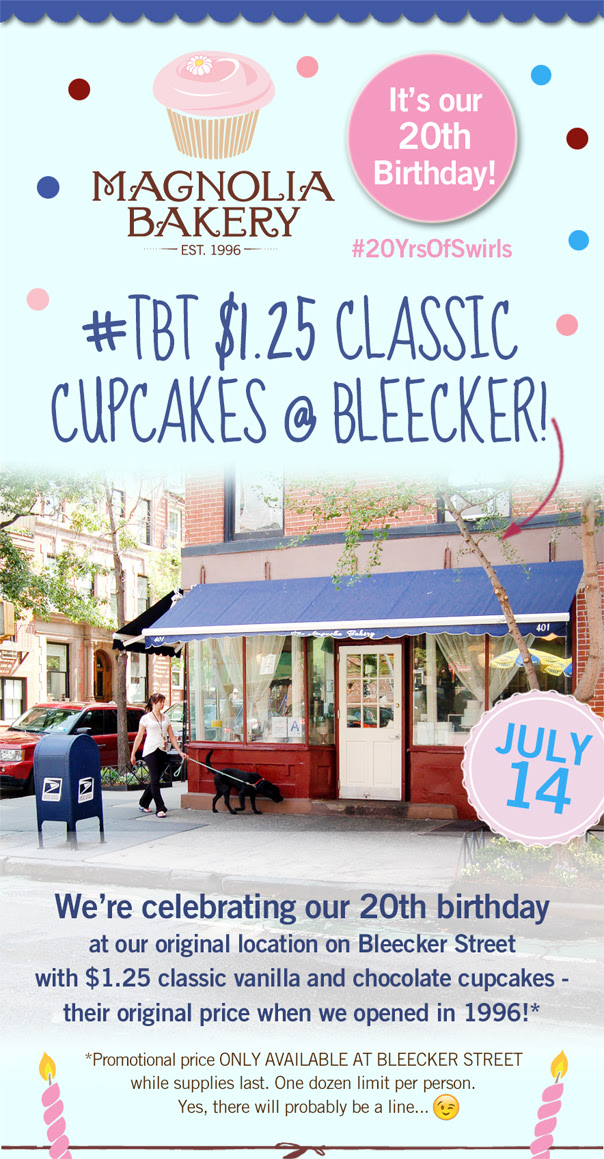
To mark its 20th anniversary in 2016, Magnolia offered cupcakes at the 1996 throwback price of $1.25. Companywide, the bakery was then selling up to 10,000 cupcakes daily.
That same year, it introduced cupcake merchandise in the form of a Carrie cupcake lapel pin. It partnered with Kate Spade for a 2015 collection of handbags and accessories that included a cupcake keychain, necklace, ring, and crossbody bag, plus a square tote sized precisely to fit a four-pack of cupcakes. Later, it collaborated to design cupcake-inspired Keds sneakers, Jenny Lemons accessories, Studiocult jewelry, and a confetti cupcase for iPhone.
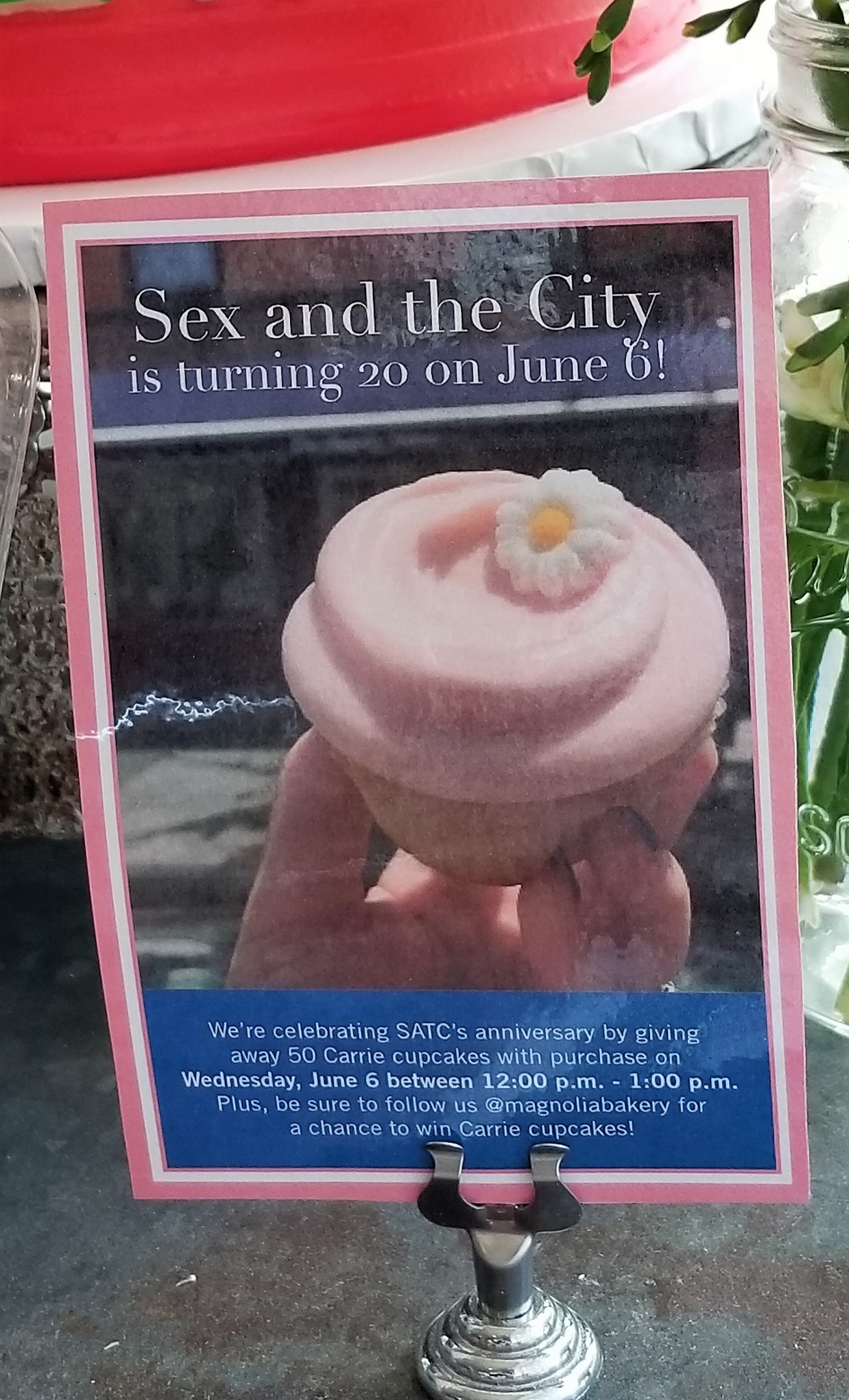
Magnolia gave away Carrie cupcakes in June 2018 to commemorate the 20th anniversary of the Sex and the City premiere. Visitors to the original location were invited to submit photos recreating the cupcake scene.
Magnolia held its 25th birthday party in July 2021 with a food truck that dispatched free banana pudding in New York. Performer Carrie Dragshaw celebrated with a Carrie cupcake on the bench.
The bakery provided Carrie cupcakes for the Sex and the City 25th anniversary promotion in 2023.

All the while, celebrities continue to appear in the lifestyle and entertainment media with Magnolia goods in hand. They include Selena Gomez, Kaia Gerber, and Josh Brolin.
Magnolia cupcakes got prominent placement in New York Times in the 2020s. “‘My Friend and I Decided to Grab Some Cupcakes Before Going Home,’” the January 2, 2022, print edition of Metropolitan Diary is headlined. Reader Derek Layes narrates a late-night cupcake run followed by a taxi ride in which the cupcake aficionados introduce the immigrant cabbie to the baked goods. In the online comments, Layes confirms the unspecified setting is Magnolia. “I loved going there late at night,” he writes. “It seemed so exotic and was always packed. And of course the cupcakes were super yummy.”
The Times reposted its Magnolia cupcake recipe to social media in 2023, advising readers, “you don’t have to wait in line. You can make Magnolia Bakery’s famous cupcakes at home.”
A 2022 Bloomberg story headlined “Teens Flock Back to Summer Jobs, With Participation at 2009 High” doesn’t mention cupcakes or bakeries in the body text. Nonetheless, editors chose to illustrate the story with a picture of workers frosting cupcakes. It’s not explicit in the caption, but the photograph unmistakably pictures Magnolia. Similarly, when the New York Times published a print and digital story about 2022 masking guidance, it pictured Magnolia as a snapshot of city life.
Magnolia cupcakes were satirized in the New Yorker in 2019. A “Shouts and Murmurs” commentary opens with a picture of a Magnolia storefront and proceeds to advise on tourist destinations. “There are tons of amazing places to explore,” the satirists declare. “But not the Empire State Building—it’s so overrated. The Statue of Liberty is also very overrated. Same with Central Park. Rockefeller Center is mediocre at best. And a lot of people love the High Line, but I am honestly not a fan. Magnolia Bakery, however, is worth the hype. Feel free to head there on your own to buy me a thank-you gift for hosting you if we don’t get the chance to go together.” The essay ends with a reminder that “my palate leans more vanilla/funfetti than chocolate/red velvet, though I haven’t had the German chocolate cupcake before and it looks really good on the Web site.”
Magnolia is invoked in a satirical list of “increasingly inconvenient MTA service advisories.” The McSweeney’s essay ridicules causes and effects of New York subway problems. Since the train isn’t running, “shuttle service will be made available via the Sex and the City tour bus, with service beginning at Steve’s Bar and stretching to Magnolia Bakery, with an intermediary stop at Carrie’s apartment.”
The Wall Street Journal reported on a large-scale franchise plan Magnolia announced in 2018. The plan didn’t come to fruition and a momentous ownership change would occur in the following years.
A powerful corporation takes the helm
Magnolia was acquired by RSE Ventures in 2021. The venture-capital firm is owned by real-estate powerhouse Stephen Ross, developer of Hudson Yards in midtown Manhattan.
Under the new ownership, Magnolia refreshed its look in 2022. It designed a new logo centered around a capital M, with the full Magnolia name appearing in a simpler, more modern font. It kept the pastel color palette evocative of frosting. “The new logo is inspired by the bakeshop’s trademarked cupcake swirl — which takes up to 40 hours to perfect — and the live theater of the bakery — mixers spinning vanilla cake batter, cupcakes being iced and banana pudding being scooped,” says the creative director behind the rebrand. “We dug through the archives and we found [the swirl] as a point of inspiration, and so you’ll see that really be elevated out into the forefront of the brand and the identity,” Magnolia’s chief marketing officer tells Marketing Brew.
Around this time, Magnolia debuted its first national TV ad. “The New Yorkers are Coming” depicts an anthropomorphic cupcake, banana pudding container, brownie, and cookie as quintessential New Yorkers marketing the brand to national consumers.
Magnolia cupcakes in the arts
Artwork inspired by Magnolia cupcakes was part of a Rockefeller Center exhibition entitled “Art in Focus.” Ceramicist Jake Clark designed vessels depicting Magnolia and other Rockefeller Center establishments. “I wanted to make sure that I really captured the essence of Midtown Manhattan,” Clark told the Rockefeller Center magazine.

“Carrie and Miranda” is a print by illustrator Rina Shin.
This is “New York Memories” by artist Carol Gillott.
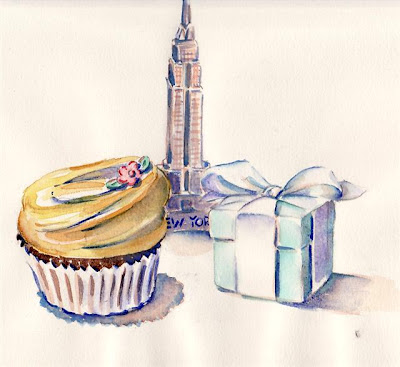
It appears in a blog post about her Magnolia cupcake research for an artwork commission. Her photographs show Magnolia’s bygone self-service cupcake system, based on filling one’s own box off readily accessible cupcake trays.
Turning to movies and TV, Magnolia was named in The Devil Wears Prada. The Andy character is allowed to leave work early, enabling her to pick up a birthday cake from Magnolia before it closes. In the 2005 film Prime, Magnolia pies are projectiles thrown at characters. A 2014 scene in the TV show Broad City takes place inside the original bakery. The Abbi character reasons that’s where she’ll find her lost cell phone because every tourist goes there as their last stop before leaving New York. Stomping into the bakery, Abbi repossesses the phone while other customers wait to order and the camera pans across the bakery interior.
Magnolia is a setting in the independent film Townhouse Confidential, a romantic comedy by author, realtor, and longtime Greenwich Village resident Rosalind Resnick. A main character works at Magnolia and cupcakes make many literal and figurative appearances as props, comedic devices, and messengers of dramatic tension. Filmed in the bakery, the movie was awarded Best Narrative Feature at the 2022 New York City Independent Film Festival.
Actress Kristin Davis launched a podcast discussing Sex and the City and the 2020s sequel, And Just Like That. In a People story announcing the podcast, Davis says, “I really cannot go to Magnolia Bakery and expect to not be recognized, and I’m cool with that.”
One OG figure unlikely to patronize Magnolia is Candace Bushnell, author of the 1996 Sex and the City book that spawned the TV show. At the launch of her Is There Still Sex in the City? book, Bushnell voiced ambivalence about the cupcake phenomenon. Seemingly without provocation, she declared in 2023, “I am NOT responsible for all of these cupcake shops.”
When Saturday Night Live staged its 50th anniversary program in February 2025, it included a tribute to cupcakes and the “Lazy Sunday” video. The retrospective medley opens with Andy Samberg and Lady Gaga. When the music changes and Chris Parnell appears on stage, Samberg and Parnell rap the first lines of “Lazy Sunday,” invoking Magnolia cupcakes. The camera then turns to dancers in cupcake costumes, among them former SNL writer Jorma Taccone.
Magnolia cupcakes as expression of personal identity
As of this writing, Magnolia is 29 years old. Children who ate cupcakes in the bakery’s earliest years are now young adults who may harbor a lifelong affinity for Magnolia cupcakes. One to carry vivid memories is Sammie Spector, daughter of a clothing boutique owner. Writing in Vogue, she recalls, “One of my earliest memories is of staring down a box of Magnolia cupcakes, eye-level on the table, surrounded by bathing suits in every style and color—adorning models, hung on large wire racks. Not the typical childhood memory, perhaps, but to be my mother’s daughter was quite special.
“I had Barbie dolls, but my dolls’ clothes were hand-sewn by Claire Pettibone, the wedding gown designer. I was lectured to keep practicing the piano, but the lecturing was done by womenswear designer Josie Natori, a concert pianist herself. And I dove head-first into cupcakes, but rarely at a kid’s birthday party; more often, I sought them out at trade shows held at the Javits Center while my mom placed orders at Huit, the French bathing suit manufacturer. Like any kid, I quickly learned who had the best sweets.”
Influenced by Magnolia, Liv Dansky aspired to become a cupcake baker in childhood. “My mom’s copy of the Magnolia Bakery cookbook was my bible growing up,” she writes in Food & Wine. “Thumbing through its glossy pages, I saw visions of my adult self owning a cupcake shop, complete with pastel pink buttercream and confetti sprinkles. By sixth grade, I attempted to turn this dream into a reality, enlisting my friend to bake over 200 cupcakes for a young entrepreneurs market held at our local bank. With our mothers’ permission, we ditched school, seized control of their decade-old KitchenAid stand mixers, and set about making every recipe in the book.”
Journalist Helen Rosner cycled from love to distain to a reconsideration of cupcakes. Her 2019 Serious Eats essay begins when she was a young New Yorker in the mid-2000s. “If Sex and the City had said something was cool, then by god, it was cool,” she writes. “I was 22, broke, and not very pretty, so my avenues of entry into that glittering world were limited. I didn’t go clubbing in the Meatpacking District, I didn’t drive around in private cars, I didn’t meet mysterious billionaires at elegant cocktail parties. But there’s one thing I did do: I ate cupcakes.”
Rosner argues Sex and the City and cupcakes fell out of favor at some point in the 2010s. At the time of her essay, cupcakes were still uncool, she posits. As for why, “I have a hypothesis: A cupcake is a woman. To be precise, a cupcake is a Sex and the City woman. Her attire gets more attention than her internal quality. She was cool for a while, but then snobs like me decided to dismiss her because she got too mass, she was too unselective about her company. Snobs like me rolled our eyes at her because she wasn’t trend-aware enough to realize how deeply uncool she was. But also: I was wrong about the Sex and the City women. I was wrong to scoff at the foursomes who shell out 50 bucks apiece to ride a pink bus around what remains of Carrie’s New York (including a stop to “Indulge in cupcakes like when Carrie confides in Miranda about Aidan”), because you know that banner I’m picking up again now? The one that says the show is actually pretty great, and we were foolish and maybe a little sexist to treat it like it was flimsy folderol, and aren’t we lucky to live in the landscape of personal independence and sexual empowerment those four characters shaped for us? Well, those women on the pink bus never put that banner down.
“I’ve been thinking about cupcakes again. About how happy they used to make me, all soft crumb and creamy top, how much joy I would get from being young and in New York and walking around a city that was familiar from television but utterly new to me, full of all the touchstones of what I thought a New York life ought to contain: zooming yellow cabs and smoky basement bars and riding the subway to work and being a real, live, actual grown-up, someone who paid rent and did her taxes and ordered drinks with confidence and would, on a particularly sunny afternoon, or after too many well drinks at some jukebox nightclub, grab a friend and go buy a cupcake to punctuate our happiness.
“So I went back to it. A group of my friends came out to celebrate my birthday a few weeks ago, and we ended up, at the end of the night, at a Lower East Side bar where I used to spend a lot of time back when cupcakes and Sex and the City were both cool. Back then, I’d adopted the bar because the drinks were cheap, the crowd was relaxed, and hey, it didn’t hurt that my very favorite cupcake shop was half a block away. A decade on, I picked it because it was near where we’d had dinner, and because, on your birthday, the two things you deserve are nostalgia and cake.
“The bar provided one; the cupcake shop, still open at this late hour and after all these years, provided the other. I grabbed a friend, and we slipped out into the night and returned after 10 minutes with winter-chapped cheeks and a dozen cupcakes, assorted. When we put the white baker’s box of treats down on the table, a cheer rose up, and I watched the people I love all reach in to peel the cakes from their paper wrappers and bury their faces in them. I had a chocolate one, topped with yellow buttercream. It was sweet and airy and buttery and rich all at once, the perfect size, the perfect shape. The cupcake was great—it was beyond great. And in that moment, as Carrie Bradshaw might say, I realized it always had been.”
Sticky as can be: The staying power of Magnolia cupcakes
On Location Tours, which has been running its Sex and the City tour since 2001, tells Curbed it’s seeing increased interest from 20somethings. When the tour gets to Magnolia, it may cross paths with other tourists lined up and/or lingering out front. The Magnolia cupcake mystique is an enduring pan-generational attraction. “It’s a lot of attention to hang on a 30-second appearance from 24 years ago, but it’s been continuous,” writes Curbed in a 2024 story.
Countless followers of the lifestyle company Pure Wow were too young to watch adult TV in 2000. Nonetheless, the Sex and the City cupcake scene was positioned first in a January 2025 Instagram post. A quarter century on, new generations of lifestyle curators are attuning to the allure.
Some real-estate listings cite proximity to Magnolia as a selling point. On the Lincoln Square page of Apartments.com, would-be renters are enticed with the option to “grab a cupcake from Magnolia Bakery.”
Michelin posted the “Ultimate West Village Guide” in May 2025. “When you’re ready for dessert, Magnolia Bakery is the obvious choice,” it writes. “Magnolia is a New York icon, famed for its heavenly cupcakes and legendary banana pudding.”
And just like that, the next chapter is being written today. Magnolia announced a domestic franchising plan, with the first store contracted for Salt Lake City in 2026.
If you can’t help but wonder, the answer is abso-f*ing-lutely, there will be another 25 years of cupcakes. And then 25 more. And so on and so on and so on.
 Andrea Adleman | Cupcakologist